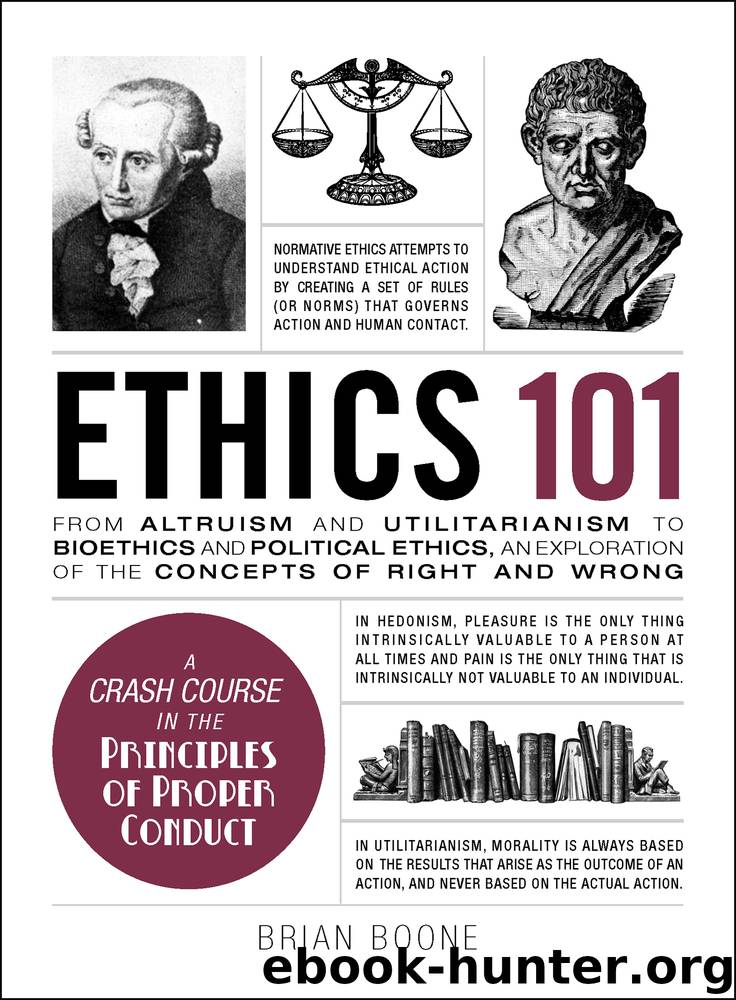
Ethics 101 by Brian Boone
Author:Brian Boone
Language: eng
Format: epub
Publisher: Adams Media
Chapter 6
EASTERN MORAL PHILOSOPHIES
In the Western tradition, ethics is viewed as a subgenre of the larger, broader field of philosophy proper. Ethics describes ways that we can practically apply (theoretically) universal principles to the situations of everyday life. Because of the predominant Judeo-Christian ethic in Europe and the Americas, philosophy has had to contend with religion for space in academic and mental spheres. More or less, philosophy has been an outgrowth of faith, and for hundreds of years philosophers in Europe and the Americas either willingly or forcibly tried to reconcile their ideas about man’s true nature with what their religions had told them was true about God, the universe, and human nature.
But in the vastly large parts of the world collectively referred to as the East, which includes India, China, Japan, and the Middle East, quite the opposite is true. In the East, religion sprang from philosophy. For example, Buddhism is viewed as a major world religion, but it’s really a spiritual system and life plan based around the teachings of a man known as the Buddha, a philosopher who was not immortal or divine, but a man who was thought to have unlocked the secrets of the universe. Taoism is also a spiritual system, not a religion, based on the ideas that opposite forces control everything, and that change is always happening and we ought to accept it and live within that framework.
There are more differences between Western and Eastern philosophies, of course. In some ways, the philosophies that came out of the East are more “pure” than Western philosophies, in that, theoretically, Eastern philosophies can be seen as approaching truth without the burden, competition, and shadows of politicized religion that bog down things in the Western world.
Eastern philosophies are also much older than Western philosophies, and it’s interesting to see how key concepts in Western philosophy developed completely independently from Eastern philosophical forms. People are people, after all. We all have the same questions, regardless of where or when we’re from. In this light, perhaps there are indeed objective truths that can be discovered about ethics and morality.
In this chapter, we’ll be looking at the philosophical contributions of some of the most important thinkers in the ancient East, and especially how those contributions are applied in the form of ethics or moral philosophy. It’s worth noting that many of these thinkers developed, honed, and spread their theories and wrote them down more than 1,000 years ago.
Download
This site does not store any files on its server. We only index and link to content provided by other sites. Please contact the content providers to delete copyright contents if any and email us, we'll remove relevant links or contents immediately.
| Anthropology | Archaeology |
| Philosophy | Politics & Government |
| Social Sciences | Sociology |
| Women's Studies |
The remains of the day by Kazuo Ishiguro(8999)
Tools of Titans by Timothy Ferriss(8396)
Giovanni's Room by James Baldwin(7346)
The Black Swan by Nassim Nicholas Taleb(7129)
Inner Engineering: A Yogi's Guide to Joy by Sadhguru(6794)
The Way of Zen by Alan W. Watts(6614)
The Power of Now: A Guide to Spiritual Enlightenment by Eckhart Tolle(5781)
Asking the Right Questions: A Guide to Critical Thinking by M. Neil Browne & Stuart M. Keeley(5775)
The Six Wives Of Henry VIII (WOMEN IN HISTORY) by Fraser Antonia(5515)
Astrophysics for People in a Hurry by Neil DeGrasse Tyson(5190)
Housekeeping by Marilynne Robinson(4447)
12 Rules for Life by Jordan B. Peterson(4304)
Ikigai by Héctor García & Francesc Miralles(4274)
Double Down (Diary of a Wimpy Kid Book 11) by Jeff Kinney(4272)
The Ethical Slut by Janet W. Hardy(4253)
Skin in the Game by Nassim Nicholas Taleb(4248)
The Art of Happiness by The Dalai Lama(4130)
Skin in the Game: Hidden Asymmetries in Daily Life by Nassim Nicholas Taleb(4006)
Walking by Henry David Thoreau(3962)
